
Eco-Justice at First UU
 Green Spot Award Winner for 2026!
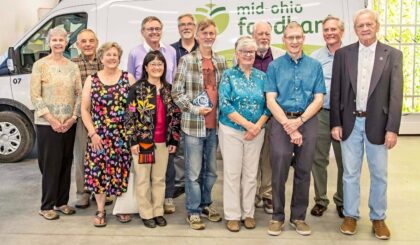
First UU has received a 2026 Green Spot Award from the City of Columbus! Staff, team members and board members attended the city-wide event on October 1st.
- Here is our press release announcing the award.
- Click HERE for the Columbus Greenspot Newsletter announcement of this and the other award winners.
Coming soon: stay tuned for information about our eco-justice themed Sunday on November 11th! We will have a special message in the 11am service followed by a reception afterwards in Beach Hall featuring our Eco-Justice Team and other environmental organizations and opportunities. (details to follow)
Environmental Justice & Sustainability at First UU
The climate crisis is one of the defining moral and spiritual challenges of our time. As Unitarian Universalists, we are called to meet it with urgency, hope, and practical action—shaping how we care for our building and grounds, use energy and resources, and partner with our neighbors for a just and sustainable future.
Our commitment to environmental justice grows directly from our Unitarian Universalist faith. Here at First UU, our Eco-Justice Team puts into practice several long-held UU principles: the inherent worth and dignity of every person; justice, equity, and compassion in human relations; and respect for the interdependent web of all existence.

The Seventh Principle: Respect for the interdependent web of all existence of which we are a part.
These commitments continue in Unitarian Universalism’s current shared values of Interdependence, Justice, and Equity, centered in Love. Interdependence reminds us that human well-being cannot be separated from the health of the Earth. Justice and Equity call us to recognize that environmental harm is not shared equally: communities already affected by racism, poverty, and other forms of injustice are often the first and most severely affected by pollution and climate change.
For us, caring for the Earth is therefore both a spiritual practice and a commitment to justice. Through the UUA’s Green Sanctuary 2030 program, we are working to deepen congregational awareness, reduce environmental harm, build community resilience, and help create a sustainable and just world for all.
For more information about our Eco Justice Team, email office@firstuucolumbus.org
Working in Partnership
Our environmental justice work begins by listening to and partnering with other local environmental groups, activists, government agencies and individuals here in Central Ohio. Our efforts include supporting Columbus’s Linden neighborhood through Connecting Community Corridors for Pollinators, People, and the Planet and working with the interfaith organization B.R.E.A.D. to expand the city’s tree canopy.
Our church grounds also include two rain gardens that help capture and filter stormwater on its path to the Olentangy River. The smaller rain garden was created with help from Friends of the Lower Olentangy Watershed (FLOW), while the larger garden bordering Weisheimer Road was developed in partnership with the City of Columbus. These living landscapes demonstrate interdependence in action—caring for our shared watershed, reducing runoff, and helping our congregation live in greater harmony with the natural systems that sustain us and the neighborhood directly around us.
People and ecosystems flourish together. Trees, native plants, and pollinator habitats support biodiversity while also providing cleaner air, cooler neighborhoods, healthier surroundings, and more welcoming public spaces.
We also encourage members of our congregation to participate in educational programs and volunteer opportunities offered by the city’s conservation team. Through learning and shared action, we seek to strengthen our relationship with the natural world and with one another.
Greening Our Congregational Life & Facility
We also strive to practice our values within our own building and daily operations. Reducing the environmental footprint of our building and grounds is one way we honor the resources we share and accept responsibility for our place in the interdependent web.
Our initiatives include:
- Expanding our solar-panel array so that solar energy now supplies more than 50 percent of the church’s electricity
- Replacing sections of the church roof with white, reflective material to reduce summer heat absorption and cooling needs
- Converting our kitchen to all-electric appliances, including an induction stove
- Replacing older lighting with energy-efficient LED fixtures in all office spaces, classrooms and public areas
- Hosting speakers from the Solid Waste Authority of Central Ohio (SWACO) to help us understand waste reduction and responsible disposal
- Publishing regular “Eco-Tips” in Friday News to help members find practical conservation ideas and opportunities for eco-justice action
Each of these efforts is just part of our larger spiritual commitment. By changing how we use energy, water, food, materials, and land, working alongside our neighbors, we seek to repair harm and nurture relationships of care, respect, and responsibility throughout the web of life.
Earlier Projects Include
Green and Growing Capital Campaign
As part of a 2016 capital campaign, appropriately titled “Green and Growing”, we made many green building improvements.
One example was the addition of the medium sized solar array above the main entrance providing clean, renewable energy right here at First UU! Renewable energy such as solar will be necessary to address climate change as it represents a reduction in our ‘carbon footprint’, mainly by offsetting coal-burning energy production here in this region.
Construction of the RE wing (currently also housing Red Oak Community School )followed LEED principals in much of its design and build including energy efficiency, focus on natural light and building materials, and reusable spaces.
As a visible commitment to our Unitarian Universalist 7th Principle (respect for the interdependent web of all existence), these are tangible and concrete ways that we can live out our faith’s values and contribute to the healing of our larger world.